

Portable vs Stationary Solar Generators : Find the Best Fit for Your Needs
The wind rustles through the trees as Jake unzips his tent, ready to make coffee with his portable solar generator. He’s deep in the mountains, far from any power outlets—but with a small, lightweight solar setup, he can charge his phone, run a mini-fridge, and keep his lantern glowing at night.
Meanwhile, across the country, Susan is preparing for a different kind of situation. A storm is on the horizon, and power outages are common in her area. She doesn’t want to worry about spoiled food, dead batteries, or sitting in the dark. Instead, she relies on her stationary solar generator for home backup, a powerful system that keeps her refrigerator, lights, and Wi-Fi running smoothly.
Both Jake and Susan are using solar generators, but their needs couldn’t be more different. So, how do you choose between a portable solar generator and a stationary solar generator for home backup? In this guide, we’ll break down the key differences, pros and cons, and which one is right for your lifestyle.
The Freedom of Power: What Is a Portable Solar Generator?
Jake had always dreamed of taking his camper van off the grid. No schedules, no crowded campgrounds—just him, the open road, and nature. But after his first trip, he hit a roadblock. His phone died, his cooler stopped running, and his only light was the moon. That’s when he realized—he needed power that could travel with him. Enter the portable solar generator.
Unlike gas generators, which need fuel and make a ton of noise, a portable solar generator runs silently and charges from the sun. It’s a compact, self-sustaining power source that fits right into your travel setup, giving you electricity no matter where you are.
How Does It Work?
Think of it as a battery-powered energy bank that recharges from the sun. It’s built to store energy during the day and power your essentials when you need them. Here’s what makes it work:
- Solar Panels – Absorb sunlight and turn it into electricity.
- Rechargeable Battery – Stores energy for later use.
- Power Inverter – Converts stored power into usable electricity.
- Multiple Output Ports – USB, AC, and DC outlets for charging different devices.
Once charged, this little powerhouse can keep your phone, laptop, lights, or even a mini-fridge running for hours.
Where Can You Use a Portable Solar Generator?
These generators are built for adventure and emergency situations alike. You might need one if:
 You’re camping or overlanding, and need to keep your lights and electronics charged.
You’re a van lifer who relies on a fridge, laptop, and fan while off-grid.
You want to power an outdoor event—from projectors to speakers.
You need a backup power source for your Wi-Fi, medical devices, or essential gadgets during a blackout.
Where It Falls Short:
While perfect for small to mid-sized power needs, these generators aren’t a solution for everything:
 Can’t handle high-energy appliances – Running a full-sized fridge or an AC unit isn’t realistic.
Dependent on recharge time – If it’s cloudy or nighttime, recharging will take longer.
Limited battery life – Once drained, you have to wait for it to recharge before using it again.
 Want a full breakdown of these limitations and how to work around them?
Check out our in-depth guide.
Want a full breakdown of these limitations and how to work around them?
Check out our in-depth guide.
Is a Portable Solar Generator Right for You?
If you want a lightweight, fuel-free, and silent power solution, a portable solar generator is a game-changer. It’s perfect for adventurers, travelers, and anyone who wants emergency backup without the hassle of gas-powered alternatives. But for long-term home backup or heavy power loads, a stationary solar generator is the better bet.
 Next, let’s explore stationary solar generators and how they compare!
Stationary Solar Generators: The Ultimate Home Power Solution
Emma had always been prepared. Living in a storm-prone area, she knew power outages could happen at any moment. But after a particularly bad winter storm left her family without electricity for three days, she realized something had to change. She needed a power backup system that wouldn’t run out of fuel, wouldn’t pollute, and could keep her home running smoothly. That’s when she discovered stationary solar generators.
What Is a Stationary Solar Generator?
While portable solar generators are compact and designed for mobility, stationary solar generators serve as permanent power backup solutions for homes, businesses, or remote locations. It’s a larger, more powerful energy system that can handle bigger appliances like refrigerators, water pumps, and even heating systems.
How Do Stationary Solar Generators Work?
Think of them as your home’s silent, sun-powered powerhouse. Here’s how they operate:
 Solar Panels Capture Sunlight – Large solar panels are installed on the roof or in an open area to absorb sunlight.
 Battery Storage Saves Energy – The captured energy is stored in a high-capacity battery bank, often lithium-ion or lead-acid.
 Inverter Converts Power – The stored electricity is converted into usable AC power, just like what comes from the grid.
 Automatic Switching – When the grid goes down, the generator kicks in automatically, keeping your home powered without interruption.
Why Choose a Stationary Solar Generator?
For those seeking a reliable and sustainable backup power source, stationary solar generators come with key benefits:
 Power for the Entire Home – Unlike portable models, these systems can handle energy-intensive appliances like refrigerators, heating and cooling units, and water pumps.
No Fuel Required – Forget about refueling gas-powered generators—this system runs on pure solar energy.
Automatic Backup – When a blackout happens, the transition is seamless—no need to start it manually.
Eco-Friendly & Quiet – No fumes, no noise, just reliable solar power.
Limitations to Consider
While these systems are incredibly useful, they do have some downsides:
Higher Upfront Cost – The investment is larger compared to portable solar generators.
Fixed Location – Unlike portable models, you can’t take it with you.
Weather Dependent – Solar power generation can slow down on cloudy days or in regions with limited sunlight.
Is a Stationary Solar Generator Right for You?
If power outages are a common issue, your household depends on high-energy appliances, or you're aiming for complete off-grid living, investing in a stationary solar generator makes perfect sense. It’s more than just a backup—it’s a sustainable and independent energy solution built for the long haul.
Next, let’s compare portable and stationary solar generators to help you decide which one fits your needs best!
Portable vs Stationary Solar Generators: Which One Fits Your Needs?
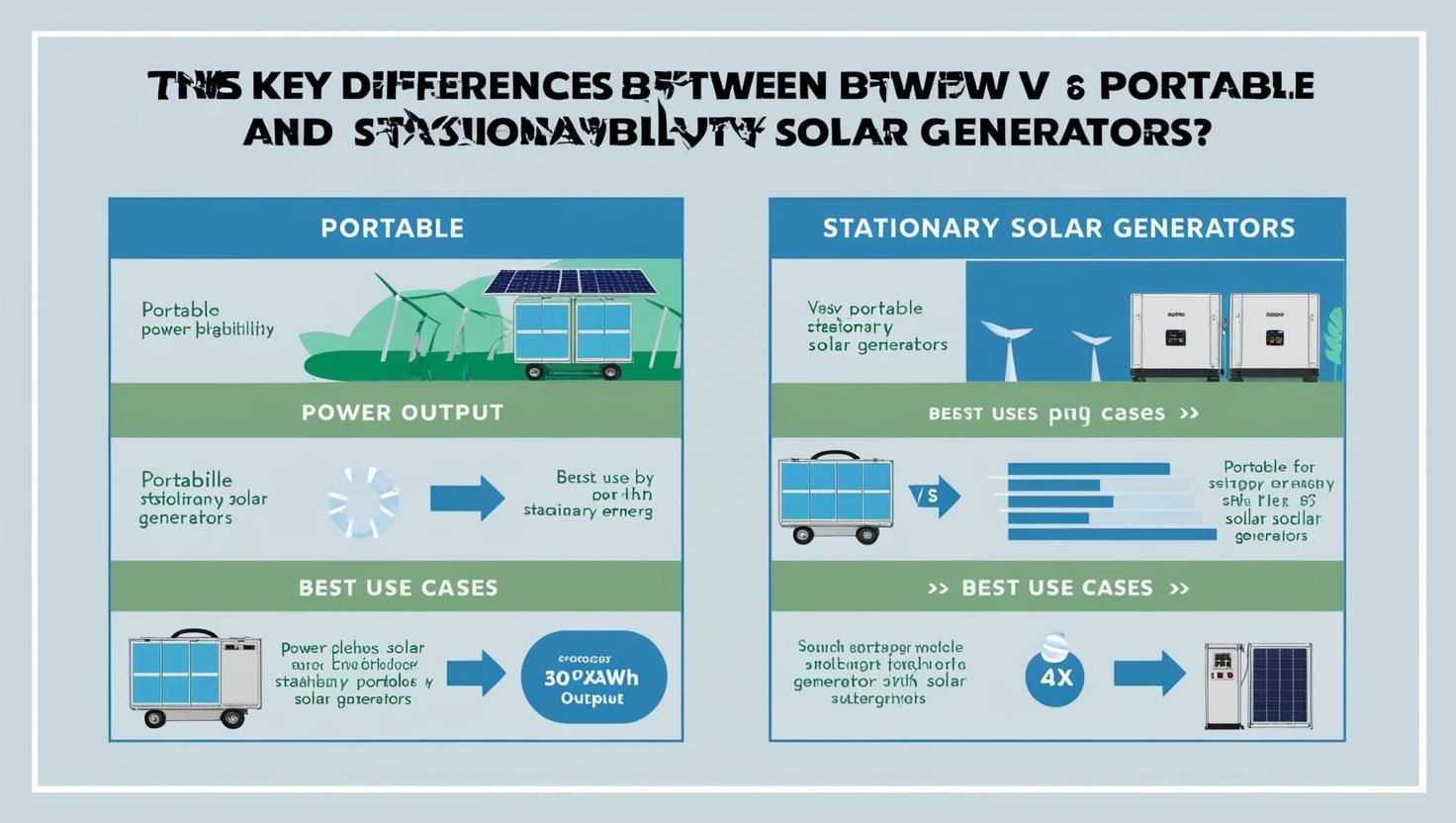
When Mark and Sarah moved to a cabin in the mountains, they had one goal—energy independence. But as they started researching solar generators, they realized there were two main options: portable and stationary.
Sarah, an adventure enthusiast, loved the idea of a lightweight power station she could take on road trips. Mark, however, was more focused on keeping their cabin running through storms and winter power outages. The big question was: Which one was the right fit?
1. Mobility vs. Permanence
- Portable Solar Generators are designed for flexibility. You can carry them to campsites, use them in an RV, or even move them around your home during short power outages. They’re compact and lightweight, making them perfect for on-the-go lifestyles.
- Stationary Solar Generators are built to stay in one place. Once installed, they provide a permanent, high-capacity power source for homes, businesses, or remote cabins. They’re not meant to be moved around but offer a more reliable, long-term energy solution.
2. Power Capacity & Appliance Support
- Portable Units are great for small electronics like phones, laptops, lights, and mini-fridges. Some high-capacity models can even run power tools or a CPAP machine overnight. But they have limits—running an air conditioner or a full-size fridge for extended periods isn’t practical.
- Stationary Generators are built for larger power needs. They can handle refrigerators, HVAC systems, well pumps, and even entire home circuits. If your goal is to keep a household running during long blackouts, stationary is the way to go.
3. Charging & Recharging
- Portable Models can charge via solar panels, wall outlets, or car adapters, making them versatile. However, solar charging takes time, especially on cloudy days.
- Stationary Systems rely solely on solar power, but with a much larger battery bank that can store excess energy for days. Some models integrate with the grid or additional battery storage for even greater reliability.
4. Cost & Installation
- Portable Generators are more budget-friendly. You can find good models for a few hundred to a couple of thousand dollars, and they require zero installation—just plug and play.
- Stationary Generators require a larger upfront investment and professional installation. However, they pay off in the long run by providing a full-home backup solution and reducing dependence on the grid.
Which One Is Right for You?
At the end of the day, it’s all about your energy needs:
Pick a Portable Solar Generator if...
You need power on the go (camping, RV, road trips). You want a backup for small electronics and occasional outages. You prefer an affordable, plug-and-play solution.
Go for a Stationary Solar Generator if...
You need whole-home power backup for long outages. You want a permanent off-grid energy solution. You don’t mind the higher cost for greater reliability.
Mark and Sarah? They decided to get both—a stationary generator for home backup and a portable one for their weekend adventures.
The best part? No more worries about power cuts or being stranded without electricity. Next, let’s dive into how to choose the right solar generator for your specific needs!
How to Choose the Right Solar Generator for Your Needs
After deciding to invest in a solar generator, Mark and Sarah faced a new challenge—choosing the right one. With so many models available, they realized they needed to prioritize their needs and understand the key factors that make a generator efficient, reliable, and worth the investment.
1. Identify Your Power Needs
The first step was figuring out how much power they actually needed. Sarah wanted something small for camping trips, while Mark needed enough power to run the essentials at home during an outage. List Essential Devices – They wrote down everything they wanted to power: phone chargers, lights, laptops, a mini-fridge, and a space heater. Check Power Ratings – Each device had a wattage rating (found on labels or manuals). A laptop might need 60W, while a refrigerator could use 150W to 600W. Calculate Total Wattage – They added up the wattage of all devices running at the same time to determine the minimum generator capacity they needed.
2. Battery Capacity & Type
Solar generators store energy in batteries, but not all batteries are created equal. Mark and Sarah compared: Lithium-Ion Batteries – Lightweight, long lifespan, fast charging. Best for portability and frequent use. Lead-Acid Batteries – Heavier but more affordable. Often used in stationary setups for whole-home power. Battery Capacity (Wh or kWh) – Higher capacity means longer runtime. A 1000Wh battery can power a 100W device for 10 hours (1000 ÷ 100 = 10).
3. Solar Input & Charging Speed
Charging speed was a big factor for Sarah since she wanted quick recharging on camping trips. Solar Panel Efficiency – Higher efficiency means faster charging. Look for monocrystalline panels, which convert more sunlight into electricity. Multiple Charging Options – Some generators allow solar, AC wall outlets, and car charging for flexibility. Charge Controller – MPPT (Maximum Power Point Tracking) controllers optimize solar input for faster, more efficient charging.
4. Portability vs. Stationary Use
Since they needed different solutions, they compared: Portable Models – Lightweight, easy to carry, best for travel and short-term power needs. Stationary Systems – Heavier, installed permanently, best for home backup and off-grid living.
5. Inverter Type & Output Ports
Pure Sine Wave Inverter – Best for sensitive electronics like laptops and medical devices. Modified Sine Wave Inverter – Cheaper but less efficient, may cause issues with some appliances. Multiple Output Ports – USB-A, USB-C, AC outlets, and DC ports for various devices.
6. Budget & Brand Reliability
Mark and Sarah checked customer reviews, warranty periods, and brand reputation before making a decision. Affordable Models ($300–$700) – Great for small appliances and camping. Mid-Range ($800–$2000) – More power, longer battery life, good for home essentials. High-End ($2000+) – Large capacity, full home backup, best for off-grid setups.
Making the Right Choice
After comparing power needs, battery capacity, charging speed, portability, and budget, they found the perfect fit: Sarah picked a portable 1000Wh lithium-ion solar generator for camping and emergencies. Mark invested in a stationary 5000Wh solar generator with solar panels and home integration for full-home backup.
No matter your needs, the right solar generator is out there—it just takes a little research to find the perfect match. Next, let’s explore the best solar generator brands and models in 2025!
Best Solar Generator Brands & Models in 2025
With so many solar generators on the market, choosing the right one can be overwhelming. To make things easier, we've compiled a detailed guide on the best solar generators for 2025—check out our in-depth reviews here.
After hours of research, Mark and Sarah found that the best brands in 2025 include EcoFlow, Jackery, Bluetti, Goal Zero, and Anker. Let’s explore why they stand out.
EcoFlow – Best for Fast Charging
 Why Choose EcoFlow?
Ultra-fast charging (80% in under an hour).
High power output—great for home backup and heavy appliances.
Smart app control for easy monitoring.
Best Model:
EcoFlow Delta Pro
- Battery Capacity: 3600Wh (Expandable up to 25kWh)
- AC Output: 3600W (7200W surge)
- Charging Speed: 1.8 hours with wall outlet, 3–6 hours with solar
- Best For: Home backup, off-grid setups, and high-energy appliances
 Want to see how EcoFlow compares to other top brands? → Check our expert comparison here.
Jackery – Best for Portability & Outdoor Use
Why Choose Jackery?
Lightweight and travel-friendly—ideal for camping and RVs.
Reliable lithium-ion battery with a long lifespan.
Plug-and-play usability—solar panel compatible.
Best Model:
Jackery Explorer 2000 Pro
- Battery Capacity: 2160Wh
- AC Output: 2200W (4400W surge)
- Charging Speed: 2 hours via wall outlet, 6–7 hours with solar
- Best For: Travelers, campers, and short-term backup power
Want the full breakdown of the Jackery Explorer 2000 Pro? → Read our detailed review.
Bluetti – Best for Long Battery Life
Why Choose Bluetti?
LiFePO4 batteries last 6x longer than standard lithium-ion.
Expandable battery system for more storage.
Reliable for both portable and stationary needs.
Best Model:
Bluetti AC200MAX
- Battery Capacity: 2048Wh (Expandable up to 8192Wh)
- AC Output: 2200W (4800W surge)
- Charging Speed: 3–4 hours with solar, 1.8 hours with AC outlet
- Best For: Extended backup power, home energy storage, and off-grid use
Thinking about getting Bluetti? → See how it compares to other top picks.
Goal Zero – Best for Rugged Durability
Why Choose Goal Zero?
Built for extreme conditions—rugged and weather-resistant.
Reliable emergency backup power.
Modular system for expandable storage.
Best Model:
Goal Zero Yeti 3000X
- Battery Capacity: 3032Wh
- AC Output: 2000W (3500W surge)
- Charging Speed: 5–6 hours with AC, 6–10 hours with solar
- Best For: Emergency preparedness, long outdoor trips, and survival situations
Need a solar generator that can handle extreme conditions? → Explore the best durable models.
 Anker – Best Budget-Friendly Option
Why Choose Anker?
Affordable without compromising quality.
Compact and easy to carry—great for small electronics.
Fast charging with good battery lifespan.
Best Model:
Anker 767 PowerHouse
- Battery Capacity: 2048Wh
- AC Output: 2300W (4600W surge)
- Charging Speed: 1.5 hours via wall outlet, 5–6 hours with solar
- Best For: Budget-conscious users, light power needs, and emergency use
On a budget? See how Anker compares to other affordable options. → Check our budget-friendly picks.
Which Solar Generator Is Right for You?
Need a home backup generator? → EcoFlow Delta or Bluetti AC200MAX. Want a lightweight and portable option? → Jackery Explorer 2000 v2. Looking for a rugged, all-terrain power station? → Goal Zero Yeti 3000X. Need a budget-friendly solar generator? → Anker 767 PowerHouse.
Still unsure? Get the full breakdown of the best solar generators in 2025 → Read our complete guide here!
Final Verdict: Which One Is Right for You?
Imagine this: You’re packing up your RV for a cross-country adventure. You need a lightweight, portable power solution to keep your gadgets charged, your mini-fridge running, and your nights well-lit. A portable solar generator is your best bet—easy to carry, quick to recharge, and perfect for life on the go.
Now, picture this instead: A storm knocks out power in your neighborhood, leaving you in the dark for days. Your fridge stops running, your heating system shuts off, and your security cameras go offline. In this case, a stationary solar generator is the better investment—powerful enough to keep your essential appliances running until the grid comes back online.
So, which one should you choose?
Pick a portable solar generator if you need power for camping, road trips, or occasional backup for small devices.
Opt for a stationary solar generator if you want a long-term, reliable home backup solution for blackouts and emergencies.
Still unsure? Check out our Best Solar Generators of 2025 guide to explore expert recommendations and find the perfect fit
 Certified Electrician & Power Systems Expert
 Looking for expert generator advice? Check out Ethan’s latest in-depth reviews and recommendations!